

 Česky (CZK)
 Slovensky (EUR)
 Austria
 Czech Republic
 Germany
 Hungary
 Poland
 Slovakia
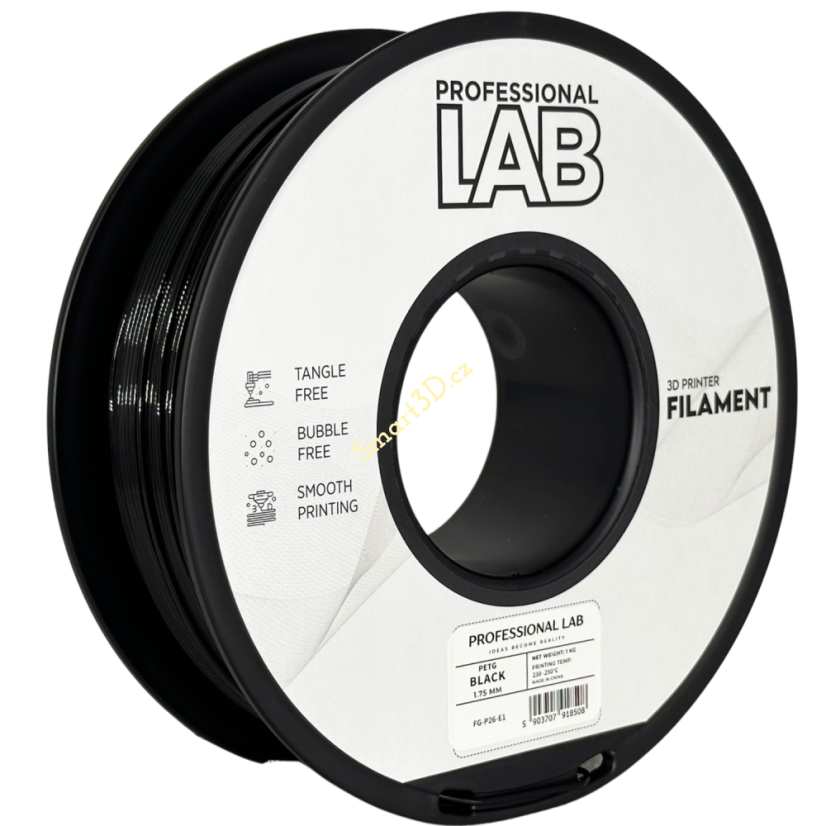
Filament PROFESSIONAL LAB / PETG / BLACK / 1,75 mm / 1 kg
Pro použití s Bambu Lab AMS LITE je třeba vytisknout redukci - viz "soubory ke stažení". For use with Bambu Lab AMS LITE is neccesary use adapter - see "files for download"

Filament PROFESSIONAL LAB / PETG / BLACK / 1,75 mm / 1 kg
Professional Lab's PETG filament is the result of extensive research and modern technological development, designed to meet the expectations of both hobbyists and advanced users in 3D printing.
With a distinct set of characteristics—such as high clarity, excellent durability, thermal resistance, and strong chemical tolerance—it proves highly effective in a wide range of demanding applications. These properties help it stand out in a crowded filament market.
Product features
Visual clarity: PETG offers outstanding transparency (88%–92% light transmission), making it ideal for visual models, display items, and clear containers.
Mechanical performance:
It provides strong tensile resistance (50–70 MPa) and high flexibility (elongation up to 300%),
making it suitable for applications that require both strength and impact resistance. It's also resilient under repeated stress.
Heat resistance: the filament keeps its shape under moderate heat (70–85°C under 0.45 MPa). It prints smoothly within a processing range of 230–260°C.
Chemical durability: PETG is not easily affected by acids, alkalis, alcohols, or oils, making it a reliable choice for items
exposed to chemicals.
Printability:
It offers smooth extrusion and strong adhesion during printing, supporting detailed and complex designs. The material can be easily polished or bonded during postprocessing. Environmental responsibility: As a recyclable material, PETG supports eco-friendly production practices.
Drying recommendations
PETG absorbs moisture from the air, which can cause issues like bubbling or poor layer bonding. For best results, dry the filament before use.
Drying temperature: 70–85°C Duration: typically 4–8 hours, depending on filament condition and equipment. Check progress after 4 hours
and extend if needed. Recommended tools: use a dedicated filament dryer for best consistency. A kitchen oven may also be used if
monitored carefully. After drying: use immediately or store in a sealed bag with desiccant to avoid moisture reabsorption.
Nozzle temperature: 230 - 250°C
Build surface material: PEI, glass
Build surface treatment: glue
Build plate temperature: 80 - 90°C
Cooling fan: 0.7
Printing speed: 30 - 70 mm/s
Raft separation distance: 0.2 mm
Retraction distance: 7 mm
Retraction speed: 20 mm/s
Environmental temperature: room temperature – 60°C
Threshold overhang angle: 60°
Based on a 0.4 mm nozzle. Printing conditions may vary with different nozzle diameters.
Printing temperature:
the printing temperature of PETG generally ranges from 230 – 250°C. However, the specific temperature may vary depending on different brands and types of materials. If the temperature is too low, the material will have poor fluidity, resulting in issues such as nozzle clogging and uneven lines. On the other hand, if the temperature is too high, the material may degrade, affecting the printing quality and
causing problems like bubbles and discoloration.
Printing speed:
a medium printing speed is recommended, usually between 40 – 60 mm/s. If the speed is too fast, the extruded material may not have enough time to cool and set, leading to model deformation and stringing. A too-slow speed will increase the printing time, reducing efficiency, and may also cause nozzle blockage due to the material staying in the nozzle for too long. Heating bed temperature: the heating bed temperature is generally set between 60 – 80°C. An appropriate heating bed temperature helps improve the adhesion of the first layer and prevent the model from warping. If the heating bed temperature is too low, the model may separate from the heating bed during printing. If it is
too high, the bottom of the model may overheat and deform.
Cooling control: PETG requires proper cooling during the printing process, but over-cooling should be avoided. The cooling fan can be turned on after printing 2 – 3 layers. It helps the material cool and set quickly, reducing deformation. However, for some parts with complex structures or overhangs, the fan speed may need to be reduced or the fan turned off to prevent stress concentration caused by rapid cooling, which could lead to model cracking or deformation.
Filament quality & storage:
choose high-quality PETG filaments. High-quality filaments have a smooth surface, uniform diameter, and few impurities, which can effectively reduce printing problems. Unused PETG filaments should be stored in a dry environment in a sealed manner to prevent them from absorbing
moisture.
Pavel Mědílek Verified review
František B. Verified review
Duso Verified review
Josef Š. Verified review
Denis Tvrdik Verified review
Verified review from a registered customer.
Related products8
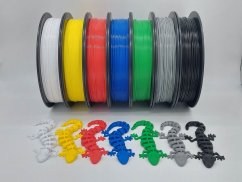
Filament COLORFIL / PLA / START PACK / 1,75 mm / 7x 0,5kg
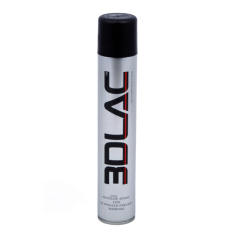
3DLAC - 400ml - sprej pro lepší přilnavost výtisků k podložce
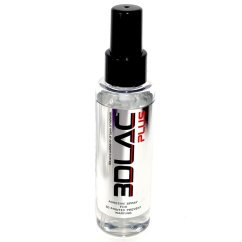
3DLAC Plus - 100ml - sprej pro lepší přilnavost výtisků k podložce
3DLAC Stick - 80ml - adhezivní lepidlo pro lepší přilnavost výtisků k podložce
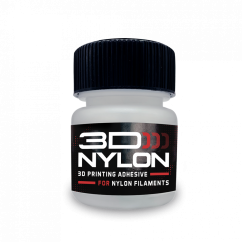
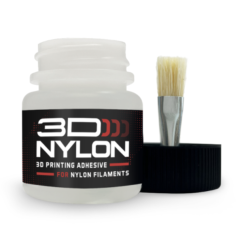
3DLAC Nylon ( 3DNYLON ) - 30ml - adhezivní lepidlo pro tisk Nylonu
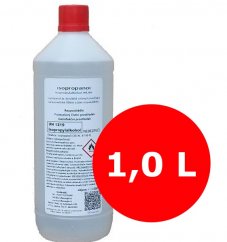
IPA Isopropylalkohol 1 L - čistič na 3D podložky a SLA tiskárny

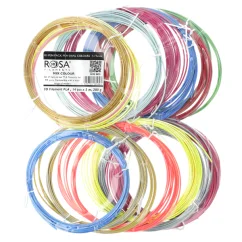
3D PEN PACK ROSA3D / PLA / DUAL COLOURS / 1,75 mm / 14 x 5m